
Tech
Discord launches Nitro Rewards, giving subscribers access to the base tier of Xbox Game Pass for no extra cost


Discord on Monday unveiled Nitro Rewards, which gives Nitro subscribers access to offers from other gaming and lifestyle brands for no additional cost.
Currently, Nitro offers upgrades to Discord itself, like more profile customization options, HD streaming, and the ability to upload files of up to 500 MB. The subscription is optional, as you can easily use the platform without paying, which is an intentional design choice on Discord’s part. But that also means user acquisition can be tricky.
“Nitro has always been about how we can meaningfully upgrade the Discord experience, but not limit it [for free users] in any large way,” Stanislav Vishnevskiy, Discord’s co-founder and CTO, told TechCrunch.
Nitro Rewards, available for both Nitro Basic ($2.99 per month) and Nitro ($9.99 per month) subscribers, is meant to improve the value for subscribers, and therefore retain them.
At launch, Nitro Rewards will provide access to the base tier of Xbox Game Pass, which lets you play more than 50 PC and Xbox games, including Fallout 4, Stardew Valley, and Day Z. The tier also includes 10 hours of cloud gaming, which lets you stream games from a PC or Xbox to other devices.
Nitro Rewards also provides discounts between 15% and 30% on a rotating selection of gaming hardware from Logitech G, SteelSeries, and KontrolFreak. Over time, Discord plans to partner with more companies for similar offers.
“Nitro is the biggest contributor to Discord revenue, and it’s been growing healthily year on year,” said Vishnevskiy. “This is about doubling down on that and providing you more value again […] It’s honestly a big thank you to [subscribers] for supporting us. But also from a business perspective, it’s better retention on subscription as well, because people have more value for it.”
Techcrunch event
San Francisco, CA
|
October 13-15, 2026
Initially conceived as a chat platform for gamers, Discord today plays a much larger role in online culture, serving as a community hub for all kinds of users — from crypto users building decentralized community projects and pub=goers organizing local craft nights to activists coordinating political protests. Discord also has an outsized role in the tech community, and founders have been using the platform to convene beta testers or power users of their products and communicate with them more directly. The platform has grown to over 90 million daily active users.
But this increased exposure means that Discord has to confront the same complex, online safety issues as larger platforms. The company is currently preparing to roll out age-verification measures as it faces more lawsuits over children’s online safety.
When you purchase through links in our articles, we may earn a small commission. This doesn’t affect our editorial independence.
>

As part of a planned data center in Pecos County, Texas, Amazon is investing in an on-site power plant that could become the largest source of climate pollution in the United States, according to The New York Times.
The NYT says the plant would burn natural gas and is permitted to release 33 million tons of carbon dioxide per year — more than any other power plant in the U.S.
In a statement, an Amazon spokesperson confirmed that the data center will “be powered by new on-site generation that won’t raise electricity costs for Texas families.” (Data centers face growing political opposition for a number of reasons, including their effect on electricity costs.)
AI has already had a significant impact on Amazon’s carbon emissions, which it reported were up 16% last year — the wrong direction for a company that pledged to eliminate its carbon emissions by 2040. And that could get worse as Amazon and tech companies back the development of huge natural gas plants to support their power-hungry data centers.
The Amazon spokesperson said, “The world looks different now than when we co-founded the climate pledge,” while also claiming, “Our commitment hasn’t changed.”
>

NextSlide recently announced that it’s joining OpenAI, with the presentation startup’s team members now working on ChatGPT.
The NextSlide website currently displays a note from founder Ahmed Beshry describing the startup’s product as one “that could turn prompts, notes, documents, or research into a polished, editable presentation.”
The ultimate goal, Beshry said, was “to make visual communication more accessible and help more people express their ideas clearly.” So by joining OpenAI, the team will “continue pursuing that same mission: building AI products that help people create, communicate, and turn their ideas into meaningful work.”
The financial terms of the deal were not disclosed. In a note on LinkedIn, Beshry said the announcement is coming “a few months late,” as the acquisition took place “earlier this year.”
Beshry was previously a co-founder at Caper AI, a smart cart/cashier-less checkout startup acquired by Instacart in 2021.
>

X, the social media platform now owned by Elon Musk’s SpaceX, is shaking up how it pays influencers and creators.
In announcing the change, the company said it will be winding down its existing Revenue Sharing program and replacing it with something called Original Content Rewards. X will stop accepting new Revenue Sharing participants, while existing participants will continue earning money through September 7.
Then, starting on September 8, they’ll be able to apply for the new program. Participants will still need to subscribe to one of X’s Premium tiers, and there will be qualifying thresholds for follower count (500 verified followers) and impressions (500,000 Home Timeline impressions from verified users in 90 days), but it sounds like the big change is the emphasis on originality.
What counts as original content? X said it can include original reporting and analysis, photos and videos created by the poster, or memes and graphics they’ve designed themselves. Commentary also counts, but “if your content regularly incorporates material created by others, you’ll need to contribute meaningful original value for it to qualify under our original content guidelines.”
The company also included examples of posts that won’t count as original, such as those just copied over from another account, downloaded from one account and re-uploaded to your own, or reposting content “without meaningful transformation.”
This announcement follows repeated attempts by X to reform the Revenue Sharing program, for example reducing payments to aggregators and “clickbait” accounts in April. But these efforts have also prompted complaints from popular accounts profiting from the current system; Musk even reversed some of those changes (giving a creator’s local audience more weight when calculating payouts) after a backlash.
In a post about the new changes, X’s Allegra Jacchia wrote that the existing program “had reached a point where its incentives were misaligned.”
“Creators should be focused on bringing net new content to the platform instead of maximizing payouts,” she said. “We could have kept adding more rules and exceptions, but ultimately the better decision was to start fresh and build a program designed from day one to reward originality.”
Jacchia added that X be “continue refining the program, improving our models, and raising the bar over time.”
When you purchase through links in our articles, we may earn a small commission. This doesn’t affect our editorial independence.
>

How to watch Storm vs. Fire: TV channel and streaming options for August 8

How to watch Rays vs. Mariners: TV channel and streaming options for August 8
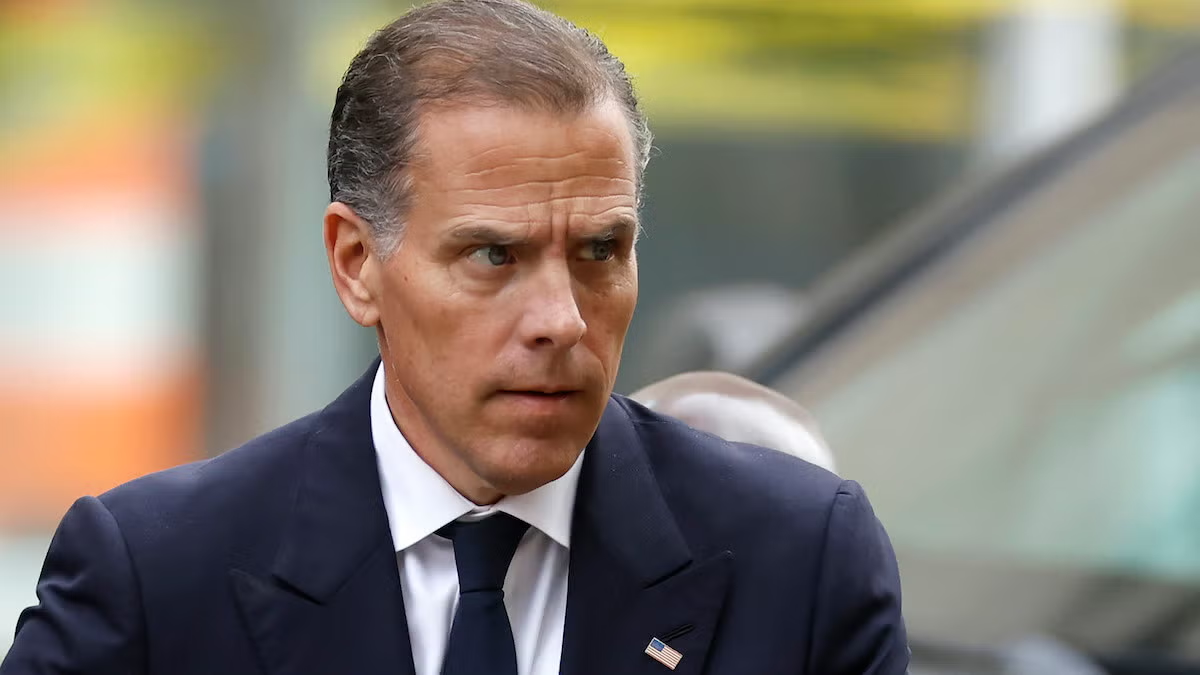
Hunter Biden Calls Trump the ‘Singular Existential Threat’ to Planet Earth
-

 movies3 months ago
Search For Canadian TV Actor Stewart McLean Now Homicide Investigation
-

 Fashion9 years ago
These ’90s fashion trends are making a comeback in 2017
-
Fashion9 years ago
According to Dior Couture, this taboo fashion accessory is back
-
Fashion9 years ago
Model Jocelyn Chew’s Instagram is the best vacation you’ve ever had
-
Fashion9 years ago
Your comprehensive guide to this fall’s biggest trends
-
Fashion9 years ago
9 Celebrities who have spoken out about being photoshopped
-
Fashion9 years ago
Emily Ratajkowski channels back-to-school style
-
Fashion9 years ago
A photo diary of the nightlife scene from LA To Ibiza