
Anime
Episode 1160 – One Piece (2026-)


© Eiichiro Oda/Shueisha, Toei Animation
Episode 1160 of One Piece continues the grand sense of adventure from last week with skill – if not necessarily haste.
After the bombastic final moments from last week’s episode, we reach a cooldown (snarf) period this week. There is no direct fighting in this week’s outing, not in the sense of opponents squaring off against one another at any rate. Nor do we get a lot of tension with regard to pending physical altercations. Instead, this is a half-and-half affair where part of the crew has conversations with giants and the other half ventures forth into Elbaph’s snowy environs.
Robin, Franky, Brook, and Jinbei have a fun conversation with the giants. It’s a bit of exposition, communication, and recap, though I think it’s worth the time spent. It is always welcome to hear the Straw Hats reaffirm their faith in Luffy, their fellow crewmembers, and the Thousand Sunny, too. Hearing the crew sing Luffy’s accolades is pretty common, but the vote of confidence in their peers is a welcome treat. It’s also fun how this half of the crew is more or less in standard new-arc pirate attire – shout out to Franky in the green jacket and gold chain, good look – while the island-bound half of the team is in their island-specific Viking gear. Most critical of all, of course, is that this has multiple moments where Nico Robin is smiling, and therefore, this is my favorite portion of the episode. But also her pointed observations about the X on Luffy’s arm in Joy Boy form are worth keeping an eye on and a fun nugget to follow for the wiki-minded theory-weavers in the audience.
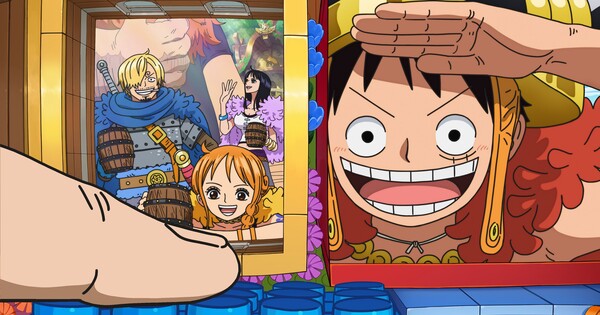
On the island of Elbaph, we get a nice dollop of adventuring fun. The crew mostly has to deal with environmental hazards, particularly the cold. For my money, the most engaging portion of this is the shots of Luffy moving around the environment. There’s something deeply charming about Luffy soaring through the air, oversized horned helm on his head and red fur coat flapping in the wind over the wide white blanket of snow covering the land. Even better is the cartoonish silhouette he leaves once he impacts the snow, rising from it only to be surrounded by giant wolves in a forest. This is classic fantasy overexaggeration and perfect fodder for One Piece. A wolf could never challenge Luffy, but what if the wolf was as big as a house? What if the trees towered into the sky? What if the inhabitants of the next island were bigger than mountains?
Speaking of big inhabitants, Loki comes into frame for us. I loved the slow build-up and zoom out to emphasize his scale. Loki being chained up is one of the most potent moments of the Elbaph arc. It will endure as a lasting, iconic image for the series, and I’m glad to see the Toei team have rendered it with such care.
Rating:
One Piece is currently streaming on
Crunchyroll.
The views and opinions expressed in this article are solely those of the author(s) and do not necessarily represent the views of Anime News Network, its employees, owners, or sponsors.
>

© Eiichiro Oda/Shueisha, Toei Animation
The last episode of the anime for this year aired on Fuji TV on Sunday, with the anime continuing next year. The Dragon Ball Super: Beerus anime will take over One Piece‘s Sunday 11:15 p.m. timeslot on Fuji TV, starting on October 11.
The Elbaph arc of the One Piece anime debuted in Japan on April 5. Crunchyroll is streaming the arc.
Toei Animation and One Piece anime producer Ryūta Koike announced in October 2025 that the anime was reducing its annual episode output to a maximum of 26 episodes moving forward starting in 2026. Following the conclusion of the Egghead arc last year, the anime took a three-month production hiatus from January-March 2026. The anime returned in April 2026 for the first of two cours (quarters of a year) with the start of the new Elbaph arc.
According to Toei Animation, the new schedule allows episodes to “incorporate more content, tempo, and pacing of the manga while continuing to leverage the unique storytelling that is only possible with animation.” Historically, with only few exceptions, the anime has aired most weeks since its premiere in 1999. However, the pace has slowed considerably over the years.

© BIRD STUDIO/SHUEISHA, TOEI ANIMATION
Dragon Ball franchise executive producer Akio Iyoku stated that work on the Dragon Ball Super: Beerus television anime series started a few years ago and is an “enhanced” edition of the Dragon Ball Super anime that features a reconstruction of the story, and includes new and redrawn cuts.
The official announcement of the anime stated:
The project features extensive new cuts, revisions to existing scenes, a complete re-rendering of all footage, newly recorded dubbing with added score and sound effects, and a full reconstruction of the story. Living up to the name ENHANCED, this edition employs the latest visual expression to deliver greater power and immersion across all scenes, especially the battle sequences. The result is an ENHANCED edition that expresses Akira Toriyama‘s original idea and worldbuilding more accurately, that will be broadcasted with highly satisfying quality.
The staff describes the story:
Several years have passed since the fierce battle against Majin Buu, and Earth has finally regained a brief moment of peace. At the same time, Beerus, the God of Destruction, awakens from his long, deep sleep. Even Kai and Supreme Kai, aware of Beerus’s overwhelming power to destroy entire planets, watch his awakening with great fear… Meanwhile, Beerus hears rumors of a Saiyan who defeated Frieza—and suddenly appears before Goku.Targeted by Beerus, the strongest being in the universe, Earth is in grave danger. Thus begins an Earth-shattering cosmic battle between the God of Destruction and Goku and his allies—a conflict that will shake the entire universe.
Dragon Ball Super premiered in July 2015 and aired for 131 episodes until March 2018. Funimation and Crunchyroll streamed the series as it aired, and Funimation released the series on home video. Funimation debuted the English dub to its streaming service in December 2016. The English dub premiered on Adult Swim‘s Toonami block in January 2017.
Sources: One Piece anime’s X/Twitter account, Oricon News
>
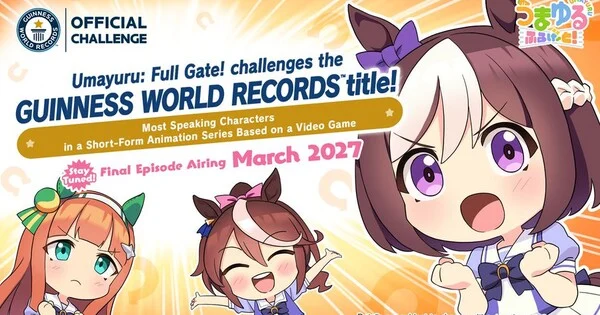
Will the horse girls achieve Most Speaking Characters in a Short-form Animation Series Based on a Video Game?
The Uma Musume Pretty Derby franchise boldly announced on Sunday that it is going for the Guinness World Record for the “Most Speaking Characters in a Short-form Animation Series Based on a Video Game” with the new short anime series Umayuru Full Gate! The staff said that Guinness World Records will reveal if Umayuru Full Gate! has broken the record in March 2027.

© Cygames, Inc.
Umayuru Full Gate! is the sequel to 2022’s Uma Yuru. The anime premiered on the franchise‘s YouTube channel on Friday. Episodes follow broadcasts of PakaLive TV.
The Uma Yuru anime series premiered in October 2022.
The Uma Musume Pretty Derby mobile game inspired both Uma Yuru and Uma Yuru: Full Gate! The Uma Musume Pretty Derby game launched in February 2021 for iOS and Android. The game was originally slated for a release in winter 2018, and was delayed in order to raise the game’s quality. The game launched on PC via DMM Games in March 2021.
Uma Musume Pretty Derby‘s English version launched for iOS and Android devices in June 2025. The game won Best Mobile Game at The Game Awards 2025.
The game’s concept begins with Uma Musume (Horse Girls), girls endowed with excellent running capability, and who aim to become top idols and compete in the national sports entertainment show “Twinkle Series.” Players take the role of both teacher and trainer for the girls in the Nihon Uma Musume Training Center Gakuen (Japan Horse Girls Training Center Academy) and help them make their debut.
Uma Musume: Cinderella Gray, the latest anime of the franchise, aired for two cours (quarters of a year) with a break in between from April to December 2025.
Sources: Uma Musume: Pretty Derby’s X/Twitter account
>
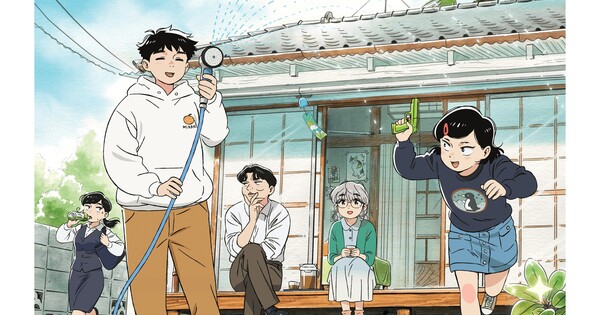
Viz Media revealed a new teaser trailer, a new key visual, and the cast for the anime of Keigo Shinzō‘s Hirayasumi manga (a co-production with Shogakukan-Shueisha Productions Co., Ltd and Production +h.) on Monday.

© Keigo Shinzo/Shogakukan/Hirayasumi Project
Yūma Uchida stars as Hiroto Ikuta, Mayu Takahashi as Natsumi Kobayashi and Rikako Aikawa as Hanae Wada.

© Keigo Shinzo/Shogakukan/Hirayasumi Project
Viz describes the human drama story:
At 29 years old, carefree Hiroto Ikuta doesn’t have a girlfriend, a full-time job, or a plan for the future—and he couldn’t be happier. Hiroto’s breezy attitude isn’t easy for everyone to understand, though. In a world filled with anxiety, confusion, and grief, Hiroto and the people around him are all just doing their best to figure out this thing called life.
Kei Suezawa (Fate/Grand Order The Movie Divine Realm of the Round Table: Camelot – Wandering: Agateram, FLCL Progressive) is directing the anime at Production +h. Naoyuki Asano (Urusei Yatsura, Keep Your Hands Off Eizouken!, Mr. Osomatsu) is designing the characters. Mika Nishimura (Dead Dead Demon’s Dededede Destruction, Typhoon Noruda) is the art director. Kaori Sawada (What Did You Eat Yesterday?, When Spring Comes) is composing the music.
The anime will premiere in January 2027 in Japan on the NHK General channel. Viz Media also announced in English a 2027 release.
Viz Media and Japan Society are also hosting the world premiere screening of the first episode at Japan Society’s location in New York City on October 7 at 7:00 p.m. EDT. Composer Kaori Sawada and producer Junichi Katsutani will be in attendance with Viz Media‘s Community Manager Godswill Ugwa as panel host.
Shinzō launched the manga in Shogakukan‘s Weekly Big Comic Spirits magazine in April 2021. Shogakukan published the manga’s ninth compiled book volume on July 30, and the series has over 1.1 million copies in circulation worldwide. The manga was nominated for the 15th Manga Taisho awards in January 2022, ranked #18 in the 2023 edition of Takarajimasha‘s Kono Manga ga Sugoi! (This Manga Is Amazing!) guidebook in December 2022, nominated for the 27th Annual Tezuka Osamu Cultural Prize in February 2023, and nominated for Best Continuing Manga Series in the 2nd American Manga Awards.
The series also inspired a live-action series, which premiered on NHK in November 2025.
Denpa has licensed Shinzō’s Holiday Junction collection of short manga. The book contains seven one-shot
manga. Shogakukan shipped the book in Japan in July 2016.
Source: press release
>
World Grand Prix Darts, day one LIVE! Luke Littler, Michael van Gerwen, Gerwyn Price and Jonny Clayton in action at double-in, double-out event | Darts News

LeBron James: NBA legend quashes retirement talk as he gets set for record-extending 24th season with Philadelphia 76ers | NBA News

England: Thomas Tuchel claims Three Lions were a danger to themselves in possession as he plays down defensive frailties | Football News
-

 movies4 months ago
Search For Canadian TV Actor Stewart McLean Now Homicide Investigation
-

 Fashion9 years ago
These ’90s fashion trends are making a comeback in 2017
-
Fashion9 years ago
According to Dior Couture, this taboo fashion accessory is back
-
Fashion9 years ago
Model Jocelyn Chew’s Instagram is the best vacation you’ve ever had
-
Fashion9 years ago
Emily Ratajkowski channels back-to-school style
-
Fashion9 years ago
9 Celebrities who have spoken out about being photoshopped
-

 Anime4 months ago
Rurouni Kenshin: Hokkaido Arc Manga Takes 1-Issue Break – News
-

 Anime3 months ago
HIDIVE to Stream English Dubs for The World Is Dancing, The Forsaken Saintess and Her Foodie Roadtrip in Another World, The Dangers in My Heart: The Movie Anime – News